Sunday, February 26, 2012

King Lear

King Lear is a play written by Shakespeare some time around 1605 or so, who knows. Well, seeing as it's the first Shakespeare anything that's been on this blog, and seeing as I refuse to edit or plan these, I'll really be trying to figure out how this is going to work during; you know, because Shakespeare is a bit different. I've been doing old books that can then be put into terms of Sylvester Stalone...that's a it weird with Shakespeare. Well, here goes.

So King Lear's a tragedy (spoiler!) about this King who decides to hand over his land o his three daughters, distributed based on how well they flatter him. His one good daughter, Cordelia, angers him really early on, and he sends her away even though he actually likes her most. His other daughters, Goneril (I know) and Regan (I know!) get the land but are totally screwy people that then screw everything up with greed ad cruelty. Meanwhile you have Edmund, bastard son of the Earl of Gloucestor, who is ticked off about being a bastard so he lashes out by getting Gloucestor to exile good ol' Edgar, his favourite son, and later on he plucks out Gloucestor's eyes. So all this is going on with a bunch of other characters, good and bad, and Lear's just overwhelmed to the point that he becomes unable to lash about anymore and just gets more and more crazy. He descends eventually very very deep into madness until they get Cordelia to talk to him whilst the evil sisters are taking over, and France is waging war. So it's all around bad really. Cordelia gets him a bit more sane but then she's hanged and he dies out of shock, really, by her side. It's very sad. Edmund dies too, along with some other characters, good and bad, and Edgar in the end says we all should just say what we think without being so shadily political about things and maybe then we can avoid repeating such a tragedy. Tadaa!

So summary done. Now, this, obviously, being Shakespeare, being Lear, is full of stuff to talk about that I can't hit or even understand in thousands of formal doctorates and things. That's true for a lot of books, most the books on this blog, really, but Lear's got that air about it though that commands you to admit to it publicly. So that's done too now. Focus: characters, of course. The characters are the most important aspect of a book. Now I could, of course do a billion things with Lear, but let's focus on ACT TWO SCENE FOUR, KING LEAR FINDING OUT THAT HIS DAUGHTERS GONERIL AND REGAN ARE COLD AND SLIMY VULTURE-LEECHES

LEAR
O, reason not the need! Our basest beggars 261
Are in the poorest thing superfluous.
Allow not nature more than nature needs,
Man’s life’s as cheap as beast’s. Thou art a lady.
If only to go warm were gorgeous, 265
Why, nature needs not what thou gorgeous wear’st,
Which scarcely keeps thee warm.
You heavens, give me that patience, patience I need!
You see me here, you gods, a poor old man,
As full of grief as age; wretched in both! 270
If it be you that stir these daughters' hearts
Against their father, fool me not so much
To bear it tamely; touch me with noble anger,
And let not women's weapons, water-drops,
Stain my man's cheeks! No, you unnatural hags, 275
I will have such revenges on you both,
That all the world shall--I will do such things,--
What they are, yet I know not: but they shall be
The terrors of the earth. You think I'll weep
No, I'll not weep: 280
I have full cause of weeping; but this heart
Shall break into a hundred thousand flaws,
Or ere I'll weep. O fool, I shall go mad!

Amaaaaziiiiing~~. So, to translate a bit, well, actually context first. Let's see. So the daughters are telling him here that they can't house him and keep him if he didn't lower the number of soldiers from a hundred to fifty, then to twenty-five, then maybe even zero. This is especially cruel because of the way it's said like some dreadful hagglers which are just trying to ruin you completely. Lear's first rejected by Goneril, and then he turns to Regan, but then Regan matches Goneril's cruelty and they gang up on him, worsening their offers, forcing Lear to yet settle for one as the lesser evil, and finally they won't even take that, breaking him even more thoroughly thereafter. It's very sad to watch this self-confident, possibly narcissistic, very voluble, very powerful king - however irrational and incompetent he may have been - be suddenly treated as dirt and he turned pathetic before the eyes of the audience by his own daughters to which he entrusted his kingdom. I sympathise with him, at least. Anyways, so when the shit hits the fan, he says the above.

Now brief translation.Regan asks 'what need one?' concerning even one soldier, so in response, Lear says not to reason for how much you need something because even a beggar has a few superfluous things, and so if you don't let people have more than they need, then you make people's lives equal to beasts'. This is reminiscent of what Hamlet says to Polonius about paying the players: 'Use every man after his desert, and who should ’scape whipping? Use them after your own honour and dignity. The less they deserve, the more merit is in your bounty.'So yeah, continuity. I'll get back to this. So then Lear says if to be gorgeous is simply to be warm, then the sisters don't have to be wearing all their trinkets. But they do. He then tells heaven that what he really needs is patience. He says he's equally wretchedly old and grieving, and that if it's the heavens that are turning the daughters against him, heaven should at least not make hi so foolish as to take the abuse complacently. Heaven ought to grant him noble anger and let him avoid shameful tears. Then he directs his speech to his daughters again, the 'unnatural hags', which is just like monstrous, and claims that he'll take his terrible revenge on them, though he doesn't know yet what exactly that will be. He says then that he won't weep, though they my expect him to and though the situation expects tears, he'll break into a hundred thousand pieces before he weeps. Then O fool, (to his fool, or clown, present on scene) I shall go mad!

Wonderful no?! Wonderful wonderful. And that's just twenty-two lines. But these are my favourite twenty-two lines. They're heartbreaking huh. Whatever sense of formality I wished to cling to for the sake of Lear is lost now. It's too amazing to stop being excited. You know, most the essays I write, in school, have the common issue of being over-excited, so I ramble. It's an issue that's not really being solved. But I digress.

Generally, what I like about it is all it's position in the play, it's significance in the psychological evolution, or I guess revolution, of Lear's character, the claim made about needs, the way he switches from speaking to the daughters and the heavens, Lear's broken speech and repetition near the end, the plea for anger, and most of all, the magnificent, glorious ending of such powerful will, and such ideals concerning suffering. So LOTS LOTS LOTS going on. LOTS. Don't you love it? Adore it? dahhhhhh it's so awesome..... So, do you think I could do all that in one blog? Don't know. It's two AM now, Swiss time...don't know why that matters, but yes, and it may take me the next five hours or so. Let's see.

Well, I'll go with the one example for each thing. ONE! k, maybe a few, but ONE in depth. All right, and I', off. Psychological evolution!!! Well, this is placed well in the beginning since it's all broad and all, so you all can get Lear's condition better. He's at this point, not had that much of a shock to his mental-state minus the bit at the beginning when Cordelia, his third and favourite daughter, refuses to flatter him pettily for land, like her sisters, and he feels so offended and unloved that he sends her off to marry in France without dowry. So Lear's probably shaken up about all that, but he still has two daughters that supposedly love him more than themselves and all good things in the world, and whom ostensibly are faithful to him through this love. He also is, in his mind, king, and he also has his fool that's been cheering him up all the while. This then, end of Act II shows for the first time what will unfold over the rest of the story. It's the spark. You see his madness to come, and the weeping provides irony concerning the fact that he does weep by the end of the play, and is probably broken into a hundred thousand pieces...emotionally. Lear loses his other daughters, cruelly, and through that, he also loses the idea of him as still 'king'. So by the end of this bit, he refers to the fool. Now I want to pause on the significance of this for a bit and that'll be it for the situation and it's significance as a cracking point and foreshadowing tool. The fool, in this time, from what I know rather unprofessionally, were these guys that knew you, if you were rich and probably royal enough, since you were an infant and would just amuse you with all potential until death. So whilst the idea of turning to a fool, by the words definition as just a stupid or easily tricked person, make the action of a 'king' addressing him in a time of need to make a personal confession of madness seem really base and sad, as though he is already mad, being solely friends with the weird kid that's amusingly witty. But no, Lear has a special connection with his fool, as it seems, many did, like Hamlet with Yorick. I guess it's sort of like Juliette and her Nurse in a way too. So anyways, turning to the fool is significant as one, it shows there's no other closer to his heart for which to rationally call for then sets to foreshadow how close Lear gets t be with his fool and thus how much the fool'd death affects Lear.

Onwards. Needs, NEEDS! by all means needs. The idea, I suppose, we've all considered some way or another. Why do we have such superfluous things? Why don't we just be like those olden people that liked fat people because that meant they're rich? Well, because cause-and-effect relations seem to have taken a back seat to what we prefer just because it's emotionally reasonably, thus comforting.

Allow not nature more than nature needs,
Man’s life’s as cheap as beast’s.

is alike to 'Use every man after his desert, and who should ’scape whipping? Use them after your own honour and dignity. The less they deserve, the more merit is in your bounty.' But just alike. The difference between the two, in meaning is I guess fundamentally, that the former discusses needs and the latter deserts; and the latter speaks of the granting above what is needed as honourable, though as somewhat expected to an extent as common courtesy, whereas King Lear expects it as purely logical, as part of nature rather than part of human society. So the difference of needs and deserts is important because it raises the question of how much Lear actually deserves, he being the father and formally he king, but at that being a bad king and an arguably bad father, and also how much Lear really needs, because in natural form, he naturally doesn't need any of these soldiers or any of the grand lifestyle he has now, but concerning the psychological state of having always been so doted upon, these superfluous things to which he clings may be necessary. Now, that past sentence was a Pandora's box that can go on, so I'll leave that at a taste.

The second difference, concerning courtesy and expectation I'll write of with a focus on the second line of Lear and the words 'scape whipping' from Hamlet. Man's life's as cheap as beast's. Firstly, the three apostrophe-s's may show that this is particularly difficult for Lear to say, especially with the as's in these too that make the same sound. So cheap is the only clear word, which is then connected strongly to beast's and needs through the double e sounds. So lots of phonetic stuff happening here that if said in a rage, can lend well to a sort of splutter, and the sounds of the double-e's then become more important in punching through the meaning despite. Moving on though. So 'needs' 'cheap' and 'beast's' are important because, well, they're nouns. I find interesting the word 'cheap' though. Can a life be cheap? Well, sure in the sense of paying for the things they need, like raising a dog's cheaper than raising a cow, and raising a cow's cheaper than raising a person. But that's because you just give the cow or dog what it needs. Hence, it makes sense, the whole, man's life's as cheap as a beast's thing, but, well,do we deserve more? According to Hamlet, we all tend to deserve whippings, like working animals, because, well, in Hamlet, the majority of the characters have done something very very wrong,save Ophelia...and Laertes...and Horatio...and the guards. Well, aside from that, why do we deserve more? I guess because we can enjoy it emotionally, and I guess because we need to see ourselves as above beasts to maintain some sanity concerning self-importance and purpose. So in saying what he needs, the daughters aren't really making a point of anything because what a man needs is not actually what he physically needs, as what one man needs is different from another, and Lear, at this point, needs his soldiers, probably as some physical form of defence to compensate for his vulnerability of age and losing Ophelia, and now his other daughters.

Switching from daughters to heaven back to daughters.

You heavens, give me that patience, patience I need!

No, you unnatural hags,

So these are the two switches and they are both in response or at least addressing what has already been said by him to the other; to the heavens, he talks of what he needs, which he's been talking to his daughters about, and then the 'no' is talking about the tears he's asking the heavens to save him from, which he continues talking of to the daughters after taking a bit of a pause to say he'll take revenge on them for his grief. So this effectively makes Lear seem to be changing audience as it occurs in his mind to, spontaneously, as his words and message birth and are expressed at once and as the trail spins out, the new directions of his speech lead him in whichever way without clear conclusions. This makes then his speech to the heavens and to his daughters very closely related. Now, this raises the question then of how much are the heavens controlling what's going on with his daughters. So I'll concentrate on this line.

If it be you that stir these daughters' hearts

You, here, is the heavens, and Lear is now addressing the heavens for direction concerning his situation like when a person is chiding you as a youth with your parents near by, and the chiding person begins addressing the parents rather than you, but about your own actions because they seem to think your parents have something to do with it all. The heavens are the parents then. Now, Lear, then, must think that he may have done something that would make the heavens do this to him, unless it's a sort of ancient Greek situation where the gods just do thing arbitrarily. That aside, if it's a Christian God, which presumably it is, this being Shakespeare and this being England, the actions of God would be somehow justified, and justifiable to man though often leaving men in doubt. Shakespeare may here then be very very subtly showing that Lear feels some form of responsibility for the beginnings to his immense grief. there is the 'If' though, that keeps all this subjective as it may be the devil controlling the girls, or just them acting evil for the sake of it. So Lear isn't sure but still, he's referring to them, which may be natural since if the youth is being really annoying and acting very naughty and won't stop it, you have to ask the parents since at least they might be able to give you some kind of helpful explanation for the youth. If that made sense. Right, so I guess I wanted to point out the significance of this switching in this sense; it's practical as the girls are really not communicative at the moment, or ever, really, and also revealing of a possible feeling of responsibility. Can Shakespeare have written this whole speech as addressed to the daughters? Well, perhaps, but it may have seemed less sympathetic towards Lear, as it seems with the address to the heavens that they too are ganging up on him and that he does feel some sort of inferiority even if to God. So good move on Willie's part, I think.

Lear's broken speech and repetition near the end!!!

No, you unnatural hags,
I will have such revenges on you both,
That all the world shall--I will do such things,--
What they are, yet I know not: but they shall be
The terrors of the earth. You think I'll weep
No, I'll not weep:

So this here is one and a bit of a sentence which isn't even finished yet but both of which are elongated because Lear keeps interrupting himself with by-the-way-comments and dashed asterisk sort of things. The 'No' at first is referring to the tears he was asking of the heavens to prevent. Let's start with that. So what follows this 'no', you'd presume to be, 'I'll not weep.' but that doesn't appear until five lines later. In those lines, he first sets his addressees as the daughters, by saying 'you unnatural hags'. Now I could go into why that's significant, considering how he was talking about nature only moments before, but I'll resist. Now, this, as I said before, is when he stops talking to the heavens, so the interlude of saying 'you unnatural hags', aside from serving the purpose of obviously insulting them, which he probably wants to do to keep face by exerting power or something, is actually practical in showing the change in addressee.

The following thing about revenge though is not exactly practical as it's implying that he won't weep by saying he'll attack rather than grieve, but still does so in a implicative way. This is when the broken speech starts. 'That all the world shall--I will do such things,--/What they are, yet I know not: but they shall be/The terror of the earth.' So the bit about 'that all the world shall' never gets finished. Shall what? Well, the dashes are clear indicators of interruptions, as always, and what follows that, which usually would complete the sentence which had been begun and interrupted, does not do so. That all the world shall what they are, yet I know not. What does that mean? So that's abandoned. Then there's the colon. Not sure what that means actually, as colons usually introduce an explanation or list. I suppose it could be the explanation of what the revenge is actually going to be.

Anyways, after that, you get the final bit of the sentence that is pretty vague too. 'the terrors of the earth.' What's that? It sounds great, sure. Perhaps similar to natural disaster? Or all the terrors alive on Earth? If the former, he'd be aligning himself with God, which you could suggest and make points about, I suppose. Well, nevertheless, a pretty strange and choppy sentence ends there; implying that he won't weep but not saying it, changing addressees, starting a sentence that doesn't end, interrupting with dashes to say something that he actually just said a moment before (I will do such things...yeah. We know [I think Lear's just assuring them because they might have mocking sceptical faces or maybe he's talking to himself, stalling to think what to say next or maybe to confirm the spontaneous plan with himself]), then admits to not really knowing what he's doing, further straying from the original strain of the sentence, and then using a questionable colon to right himself, ending with an unclear metaphor that is yet quite arresting and profound.

Finally, he says 'No' again, maybe rounding things off, and giving us the 'I'll not weep', though after the 'You think I'll weep'. Now, here's another pretty questionable punctuational thing. There's an implied pause at the end of the 'You think I'll weep', but if it was written out, it'd need some mark. Maybe 'You think I'll weep; no, I'll not weep.' That works. Anyways, maybe it's like that in other editions, I don't know, but that's probably the least of Lear's concerns at least. It reflects the breaking of his amazing rhetorical capabilities here, at least. The 'You think...' but also provides for good physical acting too, I think, in body language through facial expressions between the daughters and Lear. He could look at them and they'd be looking at him sceptically, and Lear may seem on the verge of tears.

Moving on!!! The plea for anger.

You see me here, you gods, a poor old man,
As full of grief as age; wretched in both! 270
If it be you that stir these daughters' hearts
Against their father, fool me not so much
To bear it tamely; touch me with noble anger,

So I won't do every line again but here goes. So I stuck the first few lines in there because it paints him in a piteous light. He's not a railing king, he's a poor elder that people are picking on. Then the last three lines, gosh I love them. Such romanticist stuff going on. SO much emotion, so much rage and passion. How magnificent. So he takes upon himself the grief of betrayal and dismay but he refuses to take it lying down. 'fool me not so much/ To bear it tamely; touch me with noble anger' Just saying, there's the 'tamely' connects back to the idea of beasts, added with the 'bear' which also means...well...bears, and also the 'fool' connects to the Fool he talks to a few lines later on. So I guess, on second thought, rather than ranting vaguely, I'll talk of the significance of the 'tamely' in juxtaposition with 'noble anger'.

Now 'noble anger' is not something Shakespeare made up for Lear. It's been around. The idea of nobly feeling an extreme feeling, that is. We have Hamlet wishing he could take up his sword and nobly feel the fire as the player does concerning Hecuba, and off the king. We have the debate over Romeo killing Tybalt, whether the noble anger's fine, after seeing Mercutio be killed, or whether the shame of taking that in and greeting it with patience is a fair price for considering Juliet. We have Marc Anthony tackling this issue in his satirical speech after Caesar dies, and after Lear, Shakespeare has Caliban's anger which again pull on the beauty and nobility anger bring when exerted with such passion, self-principle and persistence. Then there's the world outside Shakespeare, like Heathcliff's anger after Catherine's death or John the Savage dumping all the soma and flogging himself later on, we have the world outside England, with Chillingworth's violent vengefulness in parallel with Hester's quiet strength of endurance, with Leper yelling at Brinker at the end of the trial, and we have the world outside of English, with...well I can't think of noble anger but noble gruesomeness, I guess, like Tomas and Sabina's sexual escapades, or the commandant from the penal colony's torturous death, or, alright outside the Czech Republic...Rimbaud's poems about violent revolution...that guy being hanged in Night...Treplyov burning his book before offing himself, Hedda manically playing the piano, Antigone telling people off before she's sent off and offs herself too...Alright, so apparently I have to read more foreign literature. That was very strange. Moving on!

So that's what noble anger is, if you were wondering. Well, the idea of nobility, I guess is fundamentally a human thing, and Lear sees the Chillingworth side over the Hester side, he shows nobility through lashing out and fighting the abandoned fight rather than quietly apologising for everyone's hatred and his offence and then giving the world the silent treatment. Lear's more the yelling guy; if you're going to kill me, you're going to be beaten pretty badly before you manage. Now, do animals think this? Well, I don't think they think this but they do it. If you've got a chicken in a tiny pen and you're going to kill it, well, it really has no chance but it's going to run and peck like hell before it goes. So that's probably what Lear means when he says he won't be tamed. He's not going to foolishly head towards the guy expecting chicken food and get slaughtered instead. Now the irony with this is that he said he won't be made a beast in that bit I analysed before. Then, he meant he won't have everything taken from him like he's an animal which needs but what it needs to survive. Now he's talking about animal reactions. So he doesn't want to be an animal but he wants to act like one? Well, that's true for a lot of people, I suppose. He wants total freedom to pursue whatever he feels entitled to as a noble being. I think that's enough no? Well, please let it be yes.

FINALLY, The magnificent, glorious ending of such powerful will, and such ideals concerning suffering.

No, I'll not weep: 280
I have full cause of weeping; but this heart
Shall break into a hundred thousand flaws,
Or ere I'll weep. O fool, I shall go mad!

Well I suppose this blog was somewhat chronological then, but it worked, I think. Now just read the above excerpt again. Isn't it wonderfully powerful? So by powerful will and ideals concerning suffering, I guess I'm talking about the same thing: that he will by no means weep and will leave that last of all sufferings. 'I have full cause of weeping' That's true, I think, in context of his lifestyle. So why not weep? Lear says tears are womanish, which you have to take in account, as, well, it's the early early early 1600s. But I still think it's more than that. By womanish, I don't think he's saying he's got woman-phobia, but that it is a weakness and is demeaning. Lear has already lost so much as a King, so to debase himself further by exposing his heart and grief through tears, through pain, is unforgivable to himself. He must guard himself of emotions though all know he is in grief, and all know he is in pain. Despite, he will portray a face of cold strength that shall deprive the unnatural hags of pleasure fro their successful rampage of his dignity.

So: 'but this heart / Shall break into a hundred thousand flaws, / Or ere I'll weep.' Woah. Yeah. Awesome. I'm definitely saying that someday. I love when people say 'this + something' because you could imagine them pointing at whatever it is and thus exemplifying it over all others of it's kind and showing his control and faith over it. It's very much the 'You think I'm licked? You all think I'm licked? Well I'm not licked! And I'm going to stay right here for this lost cause!' huh. That's great. It just summarise everything I've been quoting, the You think I'll weep No, I'll not weep, and the Fight out the abandoned fight. That's James Stewart in Mr. Smith Goes to Washington. Great film, watch it, but anyways, I wouldn't be surprised if the writer was thinking back on Lear...maybe pleasantly surprised...that I may be.

Onwards. There's heart-break. No explanation needed. A hundred thousand flaw!!! There we need some words. So there's the Shall, first, which, well, have to point it out, DIFFERENT from 'will' because will is something you're willing to do and shall is something you must do. So if this heart must break, it shall; but if it shall, I will it to break within a still form, and when this heart is but crumbs and sand, then I shall break fully and then may you enjoy tears spewing from my wasted eyes, weeping for my wretched, poor, and dead heart. Hooray!!! The hundred thousand flaws though. Right. I like that he says a hundred thousand. It makes you wonder how much a heart can actually break and it's so much more dramatic than 'a lot of flaw'. ugh. 'flaws' is an interesting word. Let's end with that. Flaws is interesting because it lets you read the thing a bit differently, though probably for an indirect meaning. The direct meaning would be that flaws are like fissures in a ceiling, but here they are in a heart, and when the hundred thousandth one is made, the heart will shatter. The indirect meaning may be to do with the meaning of flaws in a heart as misdeeds, sins. If I say that guy has a flaw, I usually mean he has weird hair or he is not a mannerly person or tells really racist jokes or something. So in that sense, Lear might have a bunch of flaws in his character, and character can be metaphorically referred to as heart. Lear's flaws then. He's very proud, he has to have things go his way, he can't contain his emotions, he's not very responsible, he enjoys flattery, he is violent, and then it gets more ambiguous. But yes, he has lots of flaws. He however does not have the flaw of being a coward or weakling. Therefore, he must not cry, so maybe he says he'll take on a hundred thousand more flaws in becoming more vengeful, more violent, becoming brutish and more cruel, in cursing and in fighting and will do all such things and suffer all such flaws before he'll meet weakness standing before him and embrace that as well. This is the indirect line, I acknowledge, but in the end, it sort of happens. Lear weeps by Cordelia's body, and by the end, he has said lots of cruel things, and has gone mad, become pathetic, and become lost. he's debased to an extreme extent but still refuses to weep until the very end, at which point he shatters and falls to his long-outlasted death.

Now that's in Act II. It's amazing how much more passionate everybody in the play gets, and more twisted and pained. Concerning language though, I consider this my own personal high point. It's a turning point, and within the plot, this bit is yet early enough that planning and action need not be a part of it, leaving but evaluative reaction. That's the one flaw I see in King Lear. It's not even a flaw, really. It's my own single preference. In Romeo and Juliet, you have long stretches of wooing, of expressions of love and then suddenly something happens...the nurse talks to Romeo, and then there'd be a huge stretch of just reacting to that and expanding, expanding. In Hamlet, you have Hamlet going on and on about suicide and then the ghost appears, and then there's a huge amount of just reacting to it. Hamlet's thinking, thinking, talking to people about sub-plots that you're ish about. Caesar's a bit like King Lear in all the planning that goes about, but then you have the happening of Caesar's death, and huge reaction again with speeches, ghosts, conscience! Lear is pretty long, but it has equally as much stuff happening in it. Every scene, someone talks to someone else about someone else and there'd be lies hidden in there and conniving, and you're like, Ok, so this is going to happen, and then it happens, followed by another action, followed by another action, and it seems it's only when someone is broken that they get a voice, like Gloucester after the blinding. So I guess I just don't like when things are planned to happen and when thing happen. It's just tolerable for me. But that really is just me, and I absolutely loved Lear because even the most plotty stuff is written well enough to force you to read the whole play aloud. Anyways, if you are suddenly annoyed at me for criticising Lear, there's a bunch of praise out there to read. Act II, or the very ending of it, that is awesome. All I wanted to say.

Read, folks. Read.

FOOL
Thou should'st not have been old till thou hadst been wise.
LEAR
O, let me not be mad, not mad, sweet heaven!
Keep me in temper; I would not be mad!
(I,v)

LEAR
...this tempest in my mind...
No, I will weep no more. In such a night
To shut me out? Pour on; I will endure.
(III, iv)

EDGAR
The Prince of Darkness is a gentleman?
(III, iv)

EDGAR
When we our betters see bearing our woes,
We scarcely think our miseries our foes.
Who alone suffers suffers most i' the mind,
Leaving free things and happy shows behind:
But then the mind much sufferance doth o'er skip,
When grief hath mates, and bearing fellowship.
How light and portable my pain seems now,
When that which makes me bend makes the king bow,
He childed as I father'd! Tom, away!
Mark the high noises; and thyself bewray,
When false opinion, whose wrong thought defiles thee,
In thy just proof, repeals and reconciles thee.
What will hap more to-night, safe 'scape the king!
Lurk, lurk.
(III, vi)

OLD MAN
You cannot see you way.
GLOUCESTORI have no way, and therefore want no eyes;
I stumbled whn I saw.
(IV, i)

EDGAR
O gods! Who is't can say 'I a at the worst'? I a worse than e'er I was.
(IV, i)

GLOUCESTER
'Tis the tie's plague when ,madmen lead the blind.
(IV, i)

GLOUCESTER
Let the superfluous and lust-dieted man
(IV, i)

KENT
That from your first of difference and decay
Have followed your sad steps
(V, iii)

LEAR
And my poor fool is hang'd! No, no, no life!
Why should a dog, a horse, a rat, have life,
And thou no breath at all? Thou'lt come no more,
Never, never, never, never, never!
(V,iii)

KENT
Break, heart; I prithee, break!
(V,iii)

KENT
The wonder is, he hath endured so long:
He but usurp'd his life.
(V,iii)

EDGAR
The weight of this sad time we must obey;
Speak what we feel, not what we ought to say.
The oldest hath borne most: we that are young
Shall never see so much, nor live so long.
(V,iii)

Thursday, February 9, 2012

A Tale of Two Cities


I read A Tale of Two Cities a few months back now. I was reading it for a really long time in patches, because of business and all, but then after this weird plot hump, I was reading madly and though still at the pace of a snail, I read like a very enthused and persistent snail, and then returned to the book to do it justice, as it does deserve that. So here's my take on it, finally. Two Cities was written by Charles Dickens and was first published in 1859. Let's summarise.

So the book is has two parts, the first is pre-revolution and the other post. A lot of people say Dickens tends to start late in his novels, but from what I've read of him, i don't think he does, but for this one, thus far in my reading. It's very very slow, but you get some important facts that will be weaved into importance by the end of the bok, and you get to know the characters well. There is no clear main character, like there are in other Dickens novels, but rather a collective cast. There's Lucie, the kind-hearted and beautiful blonde, her father, Doctor Manette, Mr. Lorry, the businessman who brought the two together after the Doc was locked in the Bastille for 18 years, Sydney Carton, the loser who's devotedly in love with Lucy, Charles Darnay, and Lucie's all-around-good-guy husband. The Doctor's the big mystery for the first bit of the book, being a traumatised ex-prisoner, who was torn from his Lucie when she was yet born, and he having no remembrance as to why he was arrested. Then you clear that up, Lucie healing him, and you watch Darnay and Carton be in lpve with Lucie, and Lucie settle in in Dover with Lorry's help. Then the revolution happens, bringing the issues for the rest of the book. Darnay helps a guy out in France because he's an ex-aristocrat there (big secret) and may help, but he ends up being arrested, no help from the evil Defarges, particularly Madame (she cuts a guy's head off at one point.) Doc proves himself useful, but in the end can't help, and you finally end up with Carton tragically saving the day. I'll leave it at that.

What shall we concentrate on? Characters, of course. As with my opinion of most Dickens novels, as bitter or judgmental or unfair this may seem to more adoring fans, I find the interesting characters limited. Actually, this is not my favourite Dickens novel.The multiple character thing was a kick for it, and the historical context was a bit too overplayed. You also get lots of imagery, showing a typical landscape of the time, like a street in Paris, and the description is always loaded with such obvious metaphors and symbols that it becomes hard to look at without a smirk...at times...let's qualify. Anyways, that sounded worse than it should've. Sorry about that Dickens, I know it's your birthday today and all. Sorry.

Moving on: the focus, being it a multi-character thing with snapshots of very strong characterising scenes for individual minor characters, I'll just analyse one of such scenes.

'I wish you to know that you have been the last dream of my soul. In my degradation I have not been so degraded but that the sight of you with your father, and of this home made such a home by you, has stirred old shadows that I thought had died out of me. Since I knew you, I have been troubled by a remorse that I thought would never reproach me again, and have heard whispers from old voices impelling me upward, that I thought were silent for ever. I have had unformed ideas of striving afresh, beginning anew, shaking off sloth and sensuality, and fighting out the abandoned fight. A dream, all a dream, that ends in nothing, and leaves the sleeper where he lay down, but I wish you to know that you inspired it.'

(XIX)

Awww right? That's Carton talking to Lucie. You know, I hardly ever like romantic speeches, unless they're Shakespearean but even then, it's more for the writing than the meaning. But this one, probably my favourite confessions of love. It's so sweet and honest and profound... but on with it!

'I wish you to know' Well that's said often enough, but usually it's not said so genuinely. to actually say something so that the other knows, without expecting return, is really rare. Of course it is a bit cruel to say then, since the other, being unable to act for the speaker, is forced to live in empathetic guilt. Lucie starts crying here because the situations all so sad, and she does do things for him afterwards, as in she's very kind to him and implores Darnay (her husband) to be kind to him too. This earns him the right to be near her, which you could imagine, is everything for Carton. I mean, reading Two Cities now can make you think they're all exaggerating how bad a person Carton is. I mean he's a drunk but he's smart, remorseful, and hasn't exactly killed anyone. On the other hand, nobody seems to care that Darnay's uncle is a ridiculously terrible person and that he's been hiding his identity. On top of that, early in the book, Carton saves Darnay's life. So yeah, a bit screwy, but in Dickens' tie and considering how pretty and fragile a girl Lucie is (she faints every few chapters), I guess being a drunkard's a lot worse. Getting back to the point, considering all this, asking Lucie to know that he loves her is already asking quite a lot, but his understanding of this shows the difference between him and just a typical rambling drunkard. He's got limits and views himself with sufficient, even over the top, disdain. So I like Carton; he's sincere, humble, remorseful, and sees things deeply (even if nothing physically will change, he cares that she knows and that's all he will ask for.)

Five words done. Phew. We'll skip 'that'. 'you have been the last dream of my soul.' You have been the last dream of my soul. You have been the last dream of my soul. You have been the last dream of my soul. That's just beautiful ain't it. You have been the last dream of my soul. Alright, so I love that he says 'have been' instead of 'are'. Are is true and well, but the 'have been' is great because it doesn't say how long it's been that way but that he's been loving her quietly as a dream. That's just very nice. That you dream of something separately, alone and quietly and it turns out so beautifully in text. And the 'dream' is nice too when you think into it. A dream is not an aspiration or imposition or plan or goal or anything really; it's air slipping through your ears in a particularly colourful way. You enjoy it, and hope on it sometimes, but in the end you know that it's air, and that it won't amount to anything, probably, but you love it and need it and grow from it anyways. A dream is the world your sleeping self walks through, that it creates or itself, instantaneously, and reacts too honestly, for no one can see you. It is the mirror of your mind at it's most creative, showing everything you feel in a form that can almost fool you to be honest. When you wake from a dream, if it is wonderful, you try to remember it, and often you cannot because there is so much fiction in it and it has been so ingrained in you that before you know it, it's fallen into the quicksand of your identity. If it is really wonderful, it will find it's way above the swirls to once again grant upon your mind the playhouse of a million wishes unknown, desires unadmitted and thoughts unexpressed. Dreams are a perfect honesty that surpasses reason, or expression. They are beyond expression and hope but what you honestly want, and in the end of the day, when none of those dreams seem possible, you get to live it in the comfort of a bed, and you get to hope at least for a night, that perhaps dreams are worth more than air, which certainly they are.

Next sentence. The degradation. I love when people say 'but that'. It always trips me up. Don't know why, never will get used to it. Well, the goodness of Lucie 'stirred old shadows that I thought had died out of me.' Again, this is the LAST dream. This is a comeback spark, an underdog rising, the Red Sox coming out of nowhere for the Series. Don't know who Babe was for Carton, but he's been broken, and it sees to him that he's gone, beyond repair, and yet now there's a spark and he knows that maybe there's something left standing after the storm which is now only beginning o make it's appearance. Shadows are very much like dreams. An every-shifting form of truth that is frank and honest, but momentary, being created and killed by the sun, being blown by no wind but the movement of the earth. A shadow again, an elegant image, and Lucie has made it rise. She has resurrected something from Carton's former societal self, whenever that existed. But shadows and dreams, but better than a blank canvass presenting a cold sleep.

'Since I knew you, I have been troubled by a remorse that I thought would never reproach me again, and have heard whispers from old voices impelling me upward, that I thought were silent for ever.' Same sort of stuff really. I can go on, but this blog is about to reach the pinnacle of decadence, and I feel embarrassed enough already. However, as promised, these blogs go unedited. First write, and that's it, so let's push on forward. Yeah, so the remorse, mmhm, never...again, mmhm, whispers, yup, dreams, shadows, whispers...mmhm...old voices like old shadows, mmhm, old, like resurrect, like never-again-and-yet...mmhm...impelling upward, yeah, that's heaven, or maybe Carton's lower than the rest of society and upward's just normality...maybe, like he could stand upright again instead of hiding amongst the shrubs...right...mmhm, and silence, of course, we need silence..........shhh...... there you go, right, and thought for ever but not...again, right. So overall good sentence, right? It provides the time to get these ideas down if they weren't already. Moving on.

'I have had unformed ideas of striving afresh, beginning anew, shaking off sloth and sensuality, and fighting out the abandoned fight.' Great, we're almost there, you nonexistent readers. Don't you love when people say 'sloth'? It's so funny. I bet the animal came first. You know, I think Conrad, yeah yeah I know Conrad says Sloth frequently. These pet words man, like Dickens' 'incessantly', are so fun. Anyways, yeah we have again unformed ideas, i.e. dreams, shadows, whispers, voices, and then 'afresh', 'anew'. We all know. The meat is the last part. Isn't it great? I have had unformed ideas of...fighting out the abandoned fight.' Fighting out the abandoned fight...Fighting out the abandoned fight...Fighting out the abandoned fight...Fighting out the abandoned fight...you've got to memorise that. That's wonderful. So there's obviously a contradiction going on there. If you're fighting it out, it's not abandoned. Then how do you do it? Well, simple: Just abandon one and then say psych! So Carton abandoned love, a long while back it seems, but now, knowing he's beaten already, he's going to tap the executioner on the shoulder and say 'hey man, I know I already threw the towel, but you wanna just step back in the ring and you could beat on me a bit more?' That's the part when the guy, let's call him Apollo Creed, says 'Buddy, you kiddin' me? I dun mind, yu know, bu' you, you betta mind cus you're gon' ha' th' shi' knocked outta ya. What are yu, suicidal man? O' jus' stupid?' Then Rocky's all, 'Nah man, I jus' had this dream, yu know, where I win. I jus' beatya. I beatya! (laughs) and I know that ain't possible. It's jus' a dream, ya know? Jus' a shadow, a wakko whisper in my mind that I thought yu beat outta me las' time round but this time, ah man, I dunno man but there's somethin' goin' on that tells me tha', well, things not bein' all good and all lately, I jus' gotta fightya. I lost, I kno, to yu. You gon' kill me, I kno. But I dunno. Maybe I'm stupid. Maybe I' dum. But I ain't suicidal...nah, not that. I' livin' here. Livin'. So ge' in the ring an les figh' the abandoned fight. Beat the shi' outta me, but lemme figh the abandoned fight.' And the guys like, 'Alrigh' Rocky' and they make it to the last round and times called and sure enough, he loses but he fought, and that's what counts. And by Rocky I mean Carton. Sounds like something that should come out in Dead Poet's Society doesn't it: Fighting out the abandoned fight.

One more sentence. Let's see if I have another digression left in me. Come on....tangent. 'A dream, all a dream, that ends in nothing, and leaves the sleeper where he lay down, but I wish you to know that you inspired it.' But I wish you to know that you inspired it. That's just inspirational in itself isn't it. Gosh it's so much easier to write correctly. Anyways, there's the 'I wish you to know' again. How sweet. We've gone full circle. She is not the dream then, but the prospect of love with her is. He's grateful for her having made him a dream, one he is very pleased with, which ends in nothing, as most dreams do, but has helped him live again, to fight out the abandoned fight! Ha ha!....aw don't you just love Literature? I love you, literature dear. A dream, all a dream, that ends in nothing. Ends in nothing. Well, he understands, we've gotten that. Often one may protest too much but this, I think, is not one of those times. He, I believe, actually believes he's going down a dead end labelled dead end just because he likes the idea of hoping it's not one. And leaves the sleeper where he lay down. Where he lay down. Nothing's changed, yet again, and well, when has the sleeper ever woken otherwise...unless he's been sleepwalking. But there's just a worth in that meaningless statement because of the idea of lying, isn't there. It's so pathetic. You're like a beaten animal, that spent a bit of time writhing and then just gave in, lay there a bit. So it's a beaten animal now, maybe a half a gazelle carcass left by Apollo or something, there dreaming beyond the grave, prancing about and obtaining the crazy romantic dream of abandoned heroism and when he wakes, what is he but a dying piece of meat? Well, the difference is that those moments of prancing were bearable, and you have inspired it, and you have inspired it. Now I don't think Lucie's nearly special enough to merit such a tribute. She's nice and wonderful, and generous and hardworking, and i I met here in real life, I probably would be a huge admirer of her, but in a book, she's just another amazing person that's pretty easy to write by now. Well, aside from that, the speech is great, huh. Everything;s so evocative...has you talking...for ages, Well, hope you enjoyed some of that. The tangent wasn't there was it, this last time. Oh well. King Lear is coming soon, so maybe there.

For now though...

Read folks, Read.


Yet even when his eyes were opened on the mist and rain, on the moving patch of light from the lamps, and the hedge at the roadside retreating by jerks, the night shadows outside the coach would fall into the train of the night shadows within. The real Banking-house by Temple Bar, the real business of the past day, the real strong rooms, the real express sent after him, and the real message returned, would all be there. Out of the midst of them, the ghostly face would rise, and he would accost it again.

"Buried how long?"

"Almost eighteen years."

"I hope you care to live?"

"I can't say."

Dig--dig--dig--until an impatient movement from one of the two passengers would admonish him to pull up the window, draw his arm securely through the leathern strap, and speculate upon the two slumbering forms, until his mind lost its hold of them, and they again slid away into the bank and the grave.

"Buried how long?"

"Almost eighteen years."

"You had abandoned all hope of being dug out?"

"Long ago."

(III)


A broad ray of light fell into the garret, and showed the workman with an unfinished shoe upon his lap, pausing in his labour. His few common tools and various scraps of leather were at his feet and on his bench. He had a white beard, raggedly cut, but not very long, a hollow face, and exceedingly bright eyes. The hollowness and thinness of his face would have caused them to look large, under his yet dark eyebrows and his confused white hair, though they had been really otherwise; but, they were naturally large, and looked unnaturally so. His yellow rags of shirt lay open at the throat, and showed his body to be withered and worn. He, and his old canvas frock, and his loose stockings, and all his poor tatters of clothes, had, in a long seclusion from direct light and air, faded down to such a dull uniformity of parchment-yellow, that it would have been hard to say which was which.

(VI)


'Father,'said Young Jerry, as they walked along: taking care to keep at arm's length and to have the stool well between them: "what's a Resurrection-Man?"

Mr. Cruncher came to a stop on the pavement before he answered, "How should I know?"

"I thought you knowed everything, father," said the artless boy.

"Hem! Well," returned Mr. Cruncher, going on again, and lifting off his hat to give his spikes free play, "he's a tradesman."

"What's his goods, father?" asked the brisk Young Jerry.

"His goods," said Mr. Cruncher, after turning it over in his mind, "is a branch of Scientific goods."

"Persons' bodies, ain't it, father?" asked the lively boy.

"I believe it is something of that sort," said Mr. Cruncher.

"Oh, father, I should so like to be a Resurrection-Man when I'm quite growed up!"

Mr. Cruncher was soothed, but shook his head in a dubious and moral way. "It depends upon how you dewelop your talents. Be careful to dewelop your talents, and never to say no more than you can help to nobody, and there's no telling at the present time what you may not come to be fit for."

(XX)

"I am the resurrection and the life, saith the Lord: he that believeth in me, though he were dead, yet shall he live: and whosoever liveth and believeth in me, shall never die."

Now, that the streets were quiet, and the night wore on, the words were in the echoes of his feet, and were in the air. Perfectly calm and steady, he sometimes repeated them to himself as he walked; but, he heard them always.

The night wore out, and, as he stood upon the bridge listening to the water as it splashed the river-walls of the Island of Paris, where the picturesque confusion of houses and cathedral shone bright in the light of the moon, the day came coldly, looking like a dead face out of the sky. Then, the night, with the moon and the stars, turned pale and died, and for a little while it seemed as if Creation were delivered over to Death's dominion.

But, the glorious sun, rising, seemed to strike those words, that burden of the night, straight and warm to his heart in its long bright rays. And looking along them, with reverently shaded eyes, a bridge of light appeared to span the air between him and the sun, while the river sparkled under it.

The strong tide, so swift, so deep, and certain, was like a congenial friend, in the morning stillness. He walked by the stream, far from the houses, and in the light and warmth of the sun fell asleep on the bank. When he awoke and was afoot again, he lingered there yet a little longer, watching an eddy that turned and turned purposeless, until the stream absorbed it, and carried it on to the sea.--"Like me."

A trading-boat, with a sail of the softened colour of a dead leaf, then glided into his view, floated by him, and died away. As its silent track in the water disappeared, the prayer that had broken up out of his heart for a merciful consideration of all his poor blindnesses and errors, ended in the words, "I am the resurrection and the life."

(XXXIX)

I had never before seen the sense of being oppressed, bursting forth like a fire. I had supposed that it must be latent in the people somewhere; but, I had never seen it break out, until I saw it in the dying boy.

(XL)

'There is prodigious strength,' I answered him, 'in sorrow and in despair.'

(XL)

'I am weary, weary, weary - worn down by misery. I cannot read what I have written with this gaunt hand.'

(XL)

It is a far, far better thing I do, than I have ever done; it is a far, far better rest that I go to than I have ever known.'

(XLV)

Tuesday, January 24, 2012

Phineas and Six Stories


Phineas: Six Stories is a collection of short stories by John Knowles (author of A Separate Peace) published in 1968.

Phineas is the story that Knowles based A Separate Peace on and is actually just like an extremely shortened version of the novel but with a few extra scenes that are actually quite interesting. One, you see when Gene meets Phineas (Finny goes into an immediate talk about how many girls he's slept with) and also you see Gene before meeting Phines (he actually reveres Phineas in the sense of the coolest-kid-in-school, but the relationship is so distanced, that it's weird to see when you know how close they come to be.) The story also ends with Gene going to Finny's house in Boston, which incidentally is also where it began. Gene ends his narration by explaining that of all the things he envies of Phineas, he envies most his honesty in every bit of him, in his thoughts, heart and actions. He needs to confess to cleanse himself as he sees his birthday coming up and the adult world with it. So it's a bit more explicit about Gene's situation than A Separate Peace is, but that's basically all the difference there is between the two aside from length and the fact that the novel continues on after this scene for a long while.

That said, there are five other stories: 'A Turn in the Sun' 'Summer Street' 'The Peeping Tom' 'Martin the Fisherman' and 'Reading the Will'. They're all enjoyable and worth reading, I think, though 'Martin' and 'Summer Street' are a bit on the plainer side. 'A Turn' 'Tom' and 'Reading' all have wonderfully sharp and intriguing characters though that make them gems of stories. 'A Turn' is about a kid called Lawrence whom resembles Gene a lot. He's this loner too strange to be close friends with anyone but not weird enough to become special in the sence that Leper is in A Separate Peace. He tries to establish an identity at Devon School before he disappears forever and this one crazy, spontaneous and pure-luck dive he did into the Devon River early on helps him a bit but that turns out to resemble a miraculous season of fame for an actor that spends then the rest of his life brooding over the uniqueness of that in his career. 'Tom' is about the trial of a Peeping Tom whom you grow to sympathise with during the story. It's heart-breaking to grow more and more acquainted with the guy who eventually moves away from being an insane predator to become a tortured anti-hero, victim to his own strange quirks. A very interesting psychological path. And 'Reading' is about this kid Christopher whom recently lost his father. The strange thing is that the story's not the typical mourning story but a some-what frightening dive into the apparently cold mind of Chris as he obsesses over his inheritance whilst travelling to Egypt to bring his brother an envelope left to him. Chris, having received nothing and stuck in such a lonely situation, slowly grabs hold of your sympathy and the coldness slowly changes from cruel coldness to sad coldness as you get to know Chris' defense mechanisms. So, wonderful, lots of psychology.

All the stories have in common that. You see a character that seems simple and as you read, your opinions change of what you've judged, and meanwhile the characters themselves grow and deepen in their own awareness, making the change for you doubly impressive. I guess that's true for practically all good books, but there is a particular theme of doom and hopelessness that rules these stories that create a nice irony to this perception-shift with the plot. Your perception changes to the better of the character (that is with sympathy) but the motives of the characters remain unaccomplished and his situation bitterly static. The moving psychological elements of the short stories complement the immovable nature of doom and inevitability which is the ultimate curse of all these characters, as well with Gene and Phineas. Lightness being finely rationed in these stories, I loved them, being a prime advocate of sadness myself. If reading short stories for their lightness as compared to novels, you better steer clear of these stories, but for maybe 'Summer'. And speaking of which, last general point: the briefness of these stories and their compilation into one band invites you, obviously, to read one after the another after another in a short amount of time. This is good, I think, because this results in an army of these piercing characters that then meld, considering the greyness left by their short duration of existence, into one blur which creates then less of a person but a mood. All good writers tend to have but one thing to say that they just say over and over again. This mood, the greyness, I think is Know;es' reverberations.

Now considering it's me, this blog is far from finished, but sadly, as I'm procrastinating right now from studying for French exams (yes I do procrastinate by writing essays) I'll have to focus down. LAWRENCE! The winner of the collection, I think. Let's jump in.

The character is the most important aspect of a book. Lawrence is not one of those characters that you have and then immediately you have yourself a book. Those are people like Holmes or Heathcliff, the mysterious, a bit insane, a bit romantic (or extremely if Heathcliff), a bit bad, a bit good, a bit genius, a bit talented, a bit pensive, a bit courageous, a bit artistic and a lot active type. Those are the charismatic. Lawrence's defining characteristic is that he is precisely the opposite; he is the guy that can't manage to attain the dignity of being a total pariah but will never be popular. The mundane blob in the middle. He's not Caliban and not Oliver Twist, he's the third guy from the left while everyone else is watching the characters who actually have lines and a name. It's really pathetic because he's just so nonexistent. So how do you make that interesting? Well, you give him ambition, grant him a moment of glory, allow him an epiphany and a moment with nature, and finally conclude with some kind of irony.

Lawrence doesn't narrate. He's presented immediately in a pathetic desperate light, trying to find glory in every action, and then you learn about that moment of genuine glory. Luck glances on him for a moment with a magnificent dive into the river, which then allows you to see into his confrontations with the popular kids for a bit. This is an interesting look because Lawrence then begins displaying his ambition. How all these bits tie together is that Lawrence's mind is shown to be embittered and conniving through the ambition that is worsened by the moment of glory and rooted in his social awkwardness. He decides to get smart, really smart, in order to be known as the-smart-kid, and then be finally known. He obsesses over lacrosse and watching sports in order to achieve some social conversational points. It's all very frustrating how mathematical he gets about the teenage/high school hierarchy, considering how such hings rarely exist in such vividness as he imagines and considering how his pursuits tend to make him so intense that, ironically, he ends up scaring away potential friends. So you really grow to hate Lawrence a bit, with all his emotional spaz-outs concerning his glorified popularity problems. The good stuff eventually comes though.

At some point (it varies) you start hating Lawrence less as his crude ways become more of a curse than a flaw. This is particularly easy to do, pity him, that is, in the climactic scene (spoiler alert) when he's sitting in the trophy room and he's allowed his epiphany. It's a good one: essentially, tie passes, so don't obsess or fall into a deep depression because nothing lasts, like the trophies that after so many years get moved into storage. He then has his nature moment, seeing sunlight slit through the door, deciding it'll be a good summer, and then walking out of the trophy room feeling totally regenerated. That's a nice moment. You've got to love epiphanies. It's very artistic, the moment. I'll quote it later. So finally you end yp very proud of him. He's grown out of the annoying adolescent phase.

After all, for however much of an idiot Lawrence seems to be, concocting overly drama-queen schemes to get recognised, he hasn't been floundering about; his thoughts are very clear and logical, and very investigative too. Lawrence recognises the futility of the game he plays, so he's not an obsessed drama-queen, but he's a teenager trying to survive his age before escaping into adulthood. This epiphany is him realising that he doesn't have to play the game if he doesn't want to, and especially if he sucks at it. The board'll be cleared soon and he could go find himself and all that which is a real relief after suffering through all those awful tears of mandatory pubescence.

Moving on. The story could end there but we then have the ironic ending. How dare Knowles write a happy ending. Well, he dares not. SPOILER COMING! Really, can't resist. I'm sorry. So Lawrence, that very same day, dies. He jumps into the river and does an even better dive than his first, but then, after floating a while, cramps up and drowns. The thing is, you don't see this happen. Two kids were playing in the river and saw it happen, and couldn't save him. The principal, to whom they are describing all this, receives it with sock and despair. He asks them a bunch of questions, hinting at the doubt of suicide. The boys keep awkwardly answering that they don't know, they don't know. They, embarrassed, even try to make up answers, but then can't go through with it. They admit Lawrence didn't have any close friends, and it's all very sad indeed. The principal makes a tribute for Lawrence. He blows up a picture of him by the pool in uniform (though that swimming stuff really has very little to do with Lawrence) and place this in the trophy room; the very same in which Lawrence realised that trophy rooms are for the conventions of the wishful ones, those who try to preserve things in material that will actually disappear inevitably, with time. There's the irony I mentioned. Classic Knowles; nothing changes concerning Lawrence's situation throughout, despite the psychological change, and when you think that psych change can help him, his fate cuts him short, bringing the promised doom. Don't you just love sadness? I eat this stuff up so ravenously.

So you can have an extra become a lead guy. Sure the Ophelia ending breaks the pattern a bit. He's no nobody any longer. But, well, it's hardly a good thing anyways. And he was just healing. The character is the most important aspect of a book, but this character can be anybody. What's important is that the writer writes him well. He must provoke lots of emotions. Obviously. Anyways, there's a lot of outworn opinions for you. So innovative huh. (sarcasm) But nevertheless, important. RIP Lawrence, Good to see you again Devon, and Devon River.

Read, folks. Read.

Lawrence was neither grotesque enough nor courageous enough for that. He merely inhabited the nether world of the unregarded, where no one bothered him or bothered about him.

Bu now itt was April, and with the season of steam heat dead, Lawrence felt and saw April everywhere. He brought April with hi into the trophy room, its freshness had touched his skin, its scents were in his clothes. This room isb't a chapel at all, he thought with a passung wave of indignation, it is crypt.
Then, right there in the trophy room, he yawned, comfortably. And stretching his legs, to get the feeling of cramp out of them, he strode contentedly toward the door, through which a segment of sunlight poured down. As he stepped into it he felt its warmth on his shoulders. It was going to be a good summer.
Lawrence never knew that he was right in this, because he drowned that night, by the purest accident, in the river which winds between the playing fields.

Lawrence had cut the water almost soundlessly, and then burst up again a moment later, breaking a foaming silver circle on the black surface. Then he twisted over on his back and sank out of sight.
'I believe he enjoyed the water,' said Mr. Kuzak quietly.
'Yeah,; Bead agreed. 'He liked it a lot, I think. That was the one thing he did like. he was good in the water.'
'I don't think he cared,' Bruce remarked suddenly.
The headmaster straightened sharply. 'What do you mean?' Bruce's thoughts doubled over this instinctive statement, to sensor it or deny it, but then, because this was death, and the first he had ever really encountered, he persisted. 'I mean in the dive he just seemed to trust everything, all of a sudden. He looked different, standing up there in the bridge.'
'Happy?' asked the dean in a very low voice.
'Something like that. He wasn't scared, I know that.'

Monday, January 2, 2012

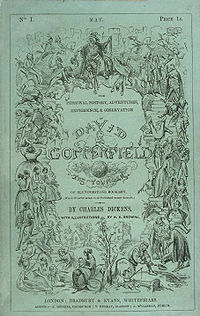
David Copperfield


I read this book maybe six months ago. It's been a while but yes, this blog is still alive, and being awoken by David Copperfield is a pretty good thing. Published in 1850, Dickens' eighth novel and one of the longer ones. It's said to be the most autobiographical of his books and in the 1867 preface, (there's an earlier one which is also good) he says David's his favourite novel: '… like many fond parents, I have in my heart of hearts a favourite child. And his name is David Copperfield.'My favourite of his too, by the way, of what I have read thus far. It's very endearing and the way all the characters weave together is quite genius. Narrating David's comments on his younger, innocent, blind self is very heart-warming and amusing at the same time. But let's get straight into it.

So the summary is that David is born (Ch.1: I am born)and then he grows up to the point where he is narrating. You meet a lot of characters including Dora, Agnes, Steerforth, Traddles, Micawber and Uriah Heep, all of which are very comical, hilarious at times, heart-breaking at others...They really are the main focus. Them and watching David grow up: hating on his step-father (with good reason), going off to a school taught by an abusive teacher (there is literally a guy with a peg leg), making friends, fancying that he is falling in love, actually falling in love, having money issues, becoming a writer, all that stuff finally ending in the classical Dickens ending: the good people are happy, the bad people are sad and we all learn a handful of morals and gain a handful of fictional friends. If you're looking for a full-on driven plot, you should probably not read this. It's more about time than action, living life than living a moment.

Now you might have seen just how long these blogs can go, and this is probably at least four times longer than all the other books I've read, so I'm making a practical decision (for once.) I'm sticking to one character only: James Steerforth, because the characters are the most important aspect of a book and this plot is too winding to try to explain. As for writing style, check this out: 'The Personal History, Adventures, Experience and Observation of David Copperfield the Younger of Blunderstone Rookery (Which He Never Meant to Publish on Any Account)' That is the original title of David Copperfield. That's pretty much the brunt of Dickens' writing style. His sentences are long, having six or seven clauses, (so this is a rather light example) and if he was in Holden's English class, Dickens would be lost amidst the shouting of 'DIGRESSION!!' Dickens calls this style 'meandering' by the way. He just goes on any tangent he wants to, any. So, moving swiftly onward.

Why do I pick James Steerforth? Well, Dickens' characters tend to be extremely unhuman. They are hardly believable as real people because they are such caricatures. Dickens is notorious for embodying a single idea or at least similar ideas, in a human form and making that his character. David = well-meaning honesty. Agnes = goodness. Uriah Heep = Evil. Dora = sweet silliness. And so on and so on. I don't think this is a fault of his, it's most likely intentional, and I think he does this to make a story more appealing to a greater mass of readers and to make more clear his intentions. He is simplifying life and humans greatly in order to bring some clarity to it. I think. So maybe his books as a whole, individually, can be a real human being. David is not a human, but the accumulation of all the characters together can add up to a complexity of attitudes, biases, backgrounds and relationships that can really mirror the confusion of the rue human being. Perhaps. Anyway, meandering...I picked Steerforth because he's one of Dickens' rarer, more complex characters.

James is complex because he clearly does bad things. He clearly has bad intentions and he clearly has bad emotions. However, unlike Uriah Heep, he seems to be aware of this and seems to want to change, to better himself, but also seems unable to. He at times falls into pits of moodiness as he laments over his inescapable badness. This conflict and the interesting idea of the inability to change, the inability to recreate yourself, is interesting and is unique amongst the characters in David Copperfield. So, let me throw some quotations out, show you what kind of person James is and show you David's interpretation of him.

Agnes, the angel of the story, warns David that he has two angels, a good one and a bad one: ‘I caution you that you have made a dangerous friend.’You the reader, have known this for quite a while. Before David even meets James he sees his name carved into a bench at school amongst other names and singles James out as probably the meanest and scariest of all the kids. Then he meets James and he seems pretty darn cool, being smooth in speech, the admiration of everyone, being older, handsome, and a daredevil. David practically falls in love with him and completely misses the fact that a few moments after meeting James, he had already swindled David out of his money, convincing him to spend his shillings on a feast for everyone. It's really mind-numbing how blind David can be, calling him 'sir' and going on huge rants when he actually is spending David's money.

James continues on doing bad stuff. I think the first time I was absolutely shocked in the book was when James insults and causes the dismissal of this really wonderful teacher, Mr. Mell, for no reason aside from his pride,boredom, and the fact that he can. David's really confused at this moment, not knowing whether to cheer for James or cry for Mr. Mell. David is so sucked into an idolatry of James by now that not even this turns him off.

This relationship is not one-sided by the way. James is not just using David to do his bidding; he actually likes David; he's actually somewhat fascinated by him. Get to that in a bit. The relationship takes a break after David leaves school and works for a while. Then David suddenly meets James in a restaurant and immediately starts crying, so glad to see him. James, after recognising David, is friendly and they just go straight to being friends, going to James' house and just hanging out. Here's where you start getting to know him better.

David goes to James' house eventually and meeting his mother, you start seeing how he got to be so messed up. James' mother absolutely idolises him. He can do no wrong in her eyes and it seems she feels so strongly the superiority of her son that she doesn't let him get any discipline, sending him to the boarding school so he wouldn't be challenged and could just live in his own splendour, and then sending him off to Oxford and just doting on him with her enormous amount of money. In short, James is spoiled both in money and compliments, and it really doesn't help his humility that he is so naturally good at everything. Then there's Miss Dartle, who lives with Mrs. Steerforth, who's obsessed with Steerforth and who James apparently scarred for life in childhood by throwing a hammer into her face. It's a dysfunctional household, and after you get out of there, James just seems so much worse and yet simultaneously, you sympathise for him more..

James and David then go to Yarmouth, where the Pegottys - David's good childhood friends or rather second family - live, and James is a huge hit. However, when they get to Yarmouth, you get to see James in one of his darker moods, saying, 'I wish to God I had had a judicious father these last twenty years! [...] I wish with all my soul I had been better guided! [...] I wish with all my soul I could guide myself better!' You really feel sorry for him then. The scene when you see him is so dark and sad, and somehow you can just excuse James all he's done by hearing his painful expression of entrapment; it seems he's aware of his faults and his mother's faults, and he seems to be in remorse and yet unable to change. Anyway, he then goes off and insults the Pegottys right after he leaves their house. David still loves him though. Here's that whole bit.

That's rather a chuckle-headed fellow for the girl; isn't he?' said Steerforth.

He had been so hearty with him, and with them all, that I felt a shock in this unexpected and cold reply. But turning quickly upon him, and seeing a laugh in his eyes, I answered, much relieved:

'Ah, Steerforth! It's well for you to joke about the poor! You may skirmish with Miss Dartle, or try to hide your sympathies in jest from me, but I know better. When I see how perfectly you understand them, how exquisitely you can enter into happiness like this plain fisherman's, or humour a love like my old nurse's, I know that there is not a joy or sorrow, not an emotion, of such people, that can be indifferent to you. And I admire and love you for it, Steerforth, twenty times the more!'

Yeah, David's well into blind love. James at this point is very endeared by David's loyalty in him. James is convinced he is a bad person but David believes so well, and considering his insecurity concerning his own misdeeds that followed the meeting with the Pegottys, this loyalty can mean a lot to James. Remember how I said James is fascinated by David. Well, this is what I mean. While he is so twisted with his inescapable coldness, David loves him purely as he loves many others. James, unknown to David, at this point has taken a fancy to Emily, Mr. Peggoty's niece, who happens to be engage to be married with the 'chuckle-headed fellow', Ham, above. So James is now in the wrong and will shortly begin pursuing Emily until he finally runs off with her (probably the worst think James does). So David's loyalty must mean all the more. He calls David Daisy, by the way, probably because of how innocent he is. James is fascinated by and envious of David's innocence and purity, really.

It's years after this amidst Jame's conniving plans to get to Emily, that Agnes warns David of James being his bad angel. David however says that whilst 'again his image, though it was still fixed in my heart, darkened', 'when he entered, and stood before me with his hand out, the darkness that had fallen on him changed to light, and I felt confounded and ashamed of having doubted one I loved so heartily.’ Needless to say yet again that David will not accept any image of James short of godliness. The interesting part about this bit is what James says when they part - which also happens to be the last time they talk since James after this goes off with Emily. James, knowing this will be the last time and knowing that he's about to become a bad person even in the eyes of Daisy, asks David to please remember him at his best. David, of course, answers that he can't possibly think of him otherwise and they have a little moment that then ends.

'Daisy,' he said, with a smile - 'for though that's not the name your godfathers and godmothers gave you, it's the name I like best to call you by - and I wish, I wish, I wish, you could give it to me!'

'Why so I can, if I choose,' said I.

'Daisy, if anything should ever separate us, you must think of me at my best, old boy. Come! Let us make that bargain. Think of me at my best, if circumstances should ever part us!'

'You have no best to me, Steerforth,' said I, 'and no worst. You are always equally loved, and cherished in my heart.'

That's basically it for James except that we find out that he eventually gets tired of Emily and leaves her, that he went off alone on his boat, and that a long while later, during a storm, his dead body is washed up on the Yarmouth shore where David fishes him out to return to his deranged mother and admirer. James thus ends up a pretty bad guy but David still remembers him at his best. To David, James died after the last meeting as the guy he loved and still does.

'I never had loved Steerforth better than when the ties that bound me to him were broken. In the keen distress of the discovery of his unworthiness, I thought more of all that was brilliant in him, I softened more towards all that was good in him, I did more justice to the qualities that might have made him a man of a noble nature and a great name, than ever I had done in the height of my devotion to him. Deeply as I felt my own unconscious part in his pollution of an honest home, I believed that if I had been brought face to face with him, I could not have uttered one reproach. I should have loved him so well still - though he fascinated me no longer - I should have held in so much tenderness the memory of my affection for him, that I think I should have been as weak as a spirit-wounded child, in all but the entertainment of a thought that we could ever be re-united. That thought I never had. I felt, as he had felt, that all was at an end between us. What his remembrances of me were, I have never known - they were light enough, perhaps, and easily dismissed - but mine of him were as the remembrances of a cherished friend, who was dead.'

So it's pretty clear David's stance on James, and I'm pretty sure mine is too. I love him probably because he's so heart-breaking, wanting to change but not being able to. He
is trapped in his own self and actually says so, and actually is a likeable guy most the time, and does still end up as he says he will so early on, bad and it seems dead because of it, according to strange Dicken's story-writing logic. You have characters like Mr. Murdstone or Creakle or Uriah that are so terrible and they all look terrible and they're actually terrible inside too, twisted and violent They each have their own explanations for being evil, like Uriah's being poor and humiliated and thus seeking vengeful rise. However, that was a transformation from victim to villain, not like James' change from victim to a reluctant, conscious, remorseful and thus self-victimised villain. He also looks really nice too, and is very accomplished. fun, witty, smart, and most of all, courageous. You then get an anti-hero type, a Jacques Lantier thing going - it is clear that he's done terrible things and is doing terrible things right in front of you, but the remorse he shows still invites pity, and helped along with David's incredibly generous descriptions of him, rather than wanting him finished, I begin wishing him to be forgiven, understood, and I wish he can get better.

In the Dickens ending of good people have good endings and bad people have bad endings, James is an anomaly. He dies, seeming then like a bad person, but that is too harsh; there is the argument of how he has already died in the eyes of David, and that then he ended with a friend's loyalty which he then betrays, making him then end now in a very sad ending, filled with conflict, inevitability and disappointment. If James had ended up marrying, say Miss Dartle, who forgives him for his young crime, one of his first probably, and she then crawls out of her bitterness to become lovely, maybe, then that would be a quite nice redemption and James may then be forgiven everything because of his change. That would balance the whole is James a good or bad person dispute - James is a reluctantly bad person that escapes his badness and becomes good - but if that were to have happened, I don't know if I'd still like him so much. It's not something so childish as liking a rebel, but that you would lose the inevitability and lack of character change that makes James so interesting.

He represents classes, if you want to start getting political, that find themselves incapable of change, and if they do, well, then that's just too good of an ending and the message would break; the message that James actually cannot change, and that David believes he can, and most of all the James wants to and is suffering under his inability. James can do everything, he's an idol. Yet he cannot simply be considerate, compassionate, innocent, honest, simple; everything David is. That's why he loves David and that's why David is so wonderful; with all these qualities, he is able to understand that there are actually two James's: one that is good and one that is bad, and that they cannot co-exist and must therefore be regarded as two different people, one overriding the other to the death out of sheer kindness. James dies twice, and that is how he has managed to, after so greatly offending David, remain loved in his heart. When reading James's attack of Mr. Mell, it becomes difficult to be so kind to him. David doesn't want to see this side of him, wants to deny the bad James' existance, which he does. That seems weak and foolish but in the grand scheme of the book, looking back at James, he seems more of a victim than a criminal somehow, the darker side of him having murdered the lighter, and I love such despairingly ironic endings.

You don't get so long of a speculation concerning many Dickens characters. Perhaps the others you could do this for are Bill Sykes, Mr. Dick, Miss Havisham, Carton...well those are the books I've read so I don't know any more, but they are, in my opinion, the more interesting and deep Dickens characters and James is my favourite. That was one character and more of a summary than anything. Amazing. Well, I'll just leave some quotations then. Happy New Years.

Read, folks. Read.

'I was not considered as being formally received into the school, however, until J. Steerforth arrived. Before this boy, who was reputed to be a great scholar, and was very good-looking, and at least half-a-dozen years my senior, I was carried as before a magistrate. He inquired, under a shed in the playground, into the particulars of my punishment, and was pleased to express his opinion that it was 'a jolly shame'; for which I became bound to him ever afterwards.'

'Let me do myself justice, however. I was moved by no interested or selfish motive, nor was I moved by fear of him. I admired and loved him, and his approval was return enough.'

'All I know of the rest of the evening is…That I was lost in blissful delirium….That I caught a view of myself in a mirror, looking perfectly imbecile and idiotic. That I retired to bed in a most maudlin state of mind, and got up in a crisis of feeble infatuation.’

‘I only know that I swim about in space, with a blue angel, in a state of blissful delirium.’

'What an idle time! What an insubstantial, happy, foolish time! Of all the times of mine that Time has in his grip, there is none that is one retrospect I can smile at half so much, and think of half so tenderly.'

'Whenever I have not had you, Agnes, to advise and approve in the beginning, I have seemed to go wild, and to get into all sorts of difficulty. When I have come to you, at last (as I have always done), I have come to peace and happiness. I come home, now, like a tired traveller, and find such a blessed sense of rest!'

'I pray Heaven that I never may forget the dear girl in her love and truth, at that time of my life; for if I should, I must be drawing near the end, and then I would desire to remember her best! She filled my heart with such good resolutions, strengthened my weakness so, by her example, so directed - I know not how, she was too modest and gentle to advise me in many words - the wandering ardour and unsettled purpose within me, that all the little good I have done, and all the harm I have forborne, I solemnly believe I may refer to her.'

There was a beggar in the street, when I went down; and as I turned my head towards the window, thinking of her calm seraphic eyes, he made me start by muttering, as if he were an echo of the morning: 'Blind! Blind! Blind!'

Wednesday, June 1, 2011

Heart of Darkness

Heart of Darkness was written in 1902 by Joseph Conrad and is one of the more overhelming books I have ever read. It's explosive to the mind, actually. I finished it yesterday and haven't stopped thinking of it since. Gosh, you have no idea, those who haven't read it. You have to try it. Here we go.

Heart of Darkness is a novella and a frame story written in first person. It's very interesting in that though it's in first person, most of the story is heard from the voice of a Charlie Marlow who our narrator is listening to. The contribution of the narrator is minimal, as is the present time of the book as most of it takes place in the past. The whole story is just whacked, distanced, unreliable because of it and realistic because of that, and so, overall down-right frightening. I recall calling The Secret Sharer unbelievably unrelaible because the Captain was crazy-ish. Well, I don't know about the narrator here, but Marlow, man does he need help. This guy is crazy and you watch him get crazy. This will be fun. Honest.

The story: Unnamed narrator is on a boat with five other guys on the Thames near London. One of the guys, Charlie Marlow, starts talking about how he got a job on a boat in Africa a while back and went to Congo. In Congo, a bunch of stuff happens, mostly revolving around how terribly the whites treat the natives, how strange things are and grotesque and eerie, and how eveypne seems to be in such reverence for this man Kurtz. Marlow then meets Kurtz after a bunch of difficulties and finds that Kurtz is just as remarkable and a genius as everyone had said, but Kurtz is now very sick and also tainted with a want for fame and fortune. Marlow is there when Kurtz dies and hears Kurtzs last words "The horror. The horror!" and then goes back to England. A year later he meets Kurtz's fiancee, tells her that the last words were her name and finally we end with the five guys and narratror looking towards where the river leads, looking into the heart of darkness that is actually Western culture or more specifically, London.

The characters are the most important aspect of a book. Gosh I've said that so many times, by now you have to believe me. The charcaters are the most important aspect of a book. Here we have marlow and we have Kurtz and then we have England and Congo as wholes really, unless we want to split the natives and the whites. Well, we have Marlow. Let's talk writing style.

So the style starts out amazingly beautiful and long-winded by the narrator and then just gets confusing a bit but simplistic enough with Marlow speaking. As the story goes on, the writing gets more and more philisophical, dense, personal, opininated, and since Marlow's opinions turn out to be more and more dark, the writing turns more and more creepy, especially since it is told in a rather matter-of-fact tone. By this time, gosh, you have to have a pretty good vocabulary. I write the words I don't know on my arm to look up later, usually, but for this book, it was impossible. My arm was covered. Well, the sophistication gets insane, but the style to is what really messes you up. You really have to read it to understand. He sort of jumps from one idea to the next very abruptly, and also jumps perspectives too, narrating the words of others, often lacking quotation marks, and the paragraphs get really long too. And you go out of the action into the mind,, going on the long streams of thought that Marlow has, and then his comments on these thoughts, a bit of action that you don't even notice because of all the surrounding thought and dream, and then you emerge out of the fog of speculation and you fid yourself without a clue as to what people are talking about, you go back and read that whole thought tornado again, find the action, go "Oh..." and then go back a couple other pages, go "Oh...huh?....Oh..." again ad then finally move on to repeat again. That's the book. That's just Marlow too. Actually more than understanding absolutely everything that happens, more important is the effect of all this. As things grow more confusing, it's as though Marlow has commandeered one part of your brain to use as a practical example in showing you just how he lost his mind and as he is conducting this experiment, he loses grip on this sanity he has grown back, and insane the experiment grows into quite the epidemic and you just go crazy reading it. That's Marlow talking and it's very effective and it's unconscious. But then there's Conrad doing his bit too as the narrator. He does all this stuff with time, jumping in and out of past and present and past and present within Marlow too. There's just so much eeriness going around and so many brain bombs. The style says it all.

Now that I comunicated that, I just don't know what to say. The thing with this book is that it's so rich that you just get lost as to what to think afterward. I bet if someone straight-up asked me a question about it, like told me to write an essay on...somethng, I would do it, and well too, but now just free and wandering, it's just, well, the book is amazing. All you want to say is quotations. They're long though...

Wow, well, let me latch on to something. Umm.. alright got it. So Marlow hears a whole lot about Kurtz before actually meeting him. That's interesting. He gets this pre-created idea of Kurtz and these prejudices before actually seeing him and then when he meets him, it's a bit confusing. He hears a lot of praise of him, that he's a genius, a Renaissance man, that he can paint, write, later on that he's a musician too, and that he's a mastermind at hunting down ivory. He's hypnotic too. He has a voice that can convince you of anything and just demand conformity from you. All this he hears and there's also the way he hears it too. He hears it from these creepy natives that are zombie-like in that they are a bit vague in thought about him, and being abused too, you get the whole idea of them being broken into by Kurtz. There's just such a mystery surrounding Kurtz, further intensifies, of course by that nobody's ever actually seen Kurtz. I mean, he's a phantom. So all that is very interesting, but personally, if I had spent three months surroundedby sinister beings and heard this, I think I'd be a bit too scared to meet kurtz and instead of revering him, I'd fear him. Marlow though feels inspired, I suppose. He imagines Kurtz as a voice more than anything else and wishes to speak to him more than anything else. So yeah, voices, creepy. I guess this idea is the one most well-shown in Apocalypse Now, which is worth watching by the way. There's this part in the movie where you see Brando as Kurtz for the first time after hearing about him for so long, (and in the movie, Willard, the movie version of Marlow, actually hears Kurtz's voice over a cassette first) and you see him for a full maybe three minutes befor you actually see his face. I mean you see this gold light on his creepy bald head and meaty ears and neck and hands and everything, hearing his voice rumbling, shivers, but you do not see the face for ever. It's maddening. You actually feel like you're going insane waiting for it. And then you see it, and the face, I mean, Marlon Brando doesn't exactly have the most unthreatening face, but in the end, the face is human but soehow itlooks like a monster. The book does the same thing but even better. The voice, the voice, Marlow obsessing and revering for no reason, the voice, the want to meet him, all the way through, the river, gettiing closer, the steerer dying, the eeriness, the stakes with heads, the natives, the grotesque atmosphere all around and then the voice again, obsessively and finally, finally you meet Kurtz and it just happens so abruptly. He just appears really suddenly and he's absolutley insignificant. he's frail, sickly and immediately Marlow is astounded.

You know, this may be one of the worst blogs I've written. You know, that's probably just because I'm trying to describe a dream. That's what this book is, a very well-written dream, and well-written because when it is over, all you have with you, all you have left is an impression of what happened. You could read analyses of this book. You could read a whole bunch of them because there is literally no limit to things that people can say about it, but in the end, while analyses can be infinitely helpful for many books that mean to articulate a message or show a beautiful plot or person, this one is different. This is my first reading, mind, and that means I'm still absolutely an idiot when it comes to this book. Still, though my argument stands. What you analyse when reading a book is what the author does to create the book, and that is like pulling apart a flower to see how it's created. The beauty of a flower can very well be the individual cells and sinews and fibers, but the visible, simplistic wonder of it is the bloom. The author's work is a trick. I person may not understand why he feels sorrow but he feels it anyway, and later on, he may not understand that this sympathy he feels now is felt because of the previous sadness and the similarities in diction at these two momements combined with some strength in irony and some continuity through motif, but he still feels sympathy, and he still feels the message derived from this sympathy and he feels it all just as true despite not knowing. Only biologists like cells like they do, I mean, I hate cells, but I love flowers. So don't judge me for loving semicolons but don't judge me for not knowing yet how Conrad used them. I only love Heart of Darkness, and I will love it even more in the times to come, but you could never read an analysis and love it just as much as if you did. The thing is to love books. You either love or you don't. There's no grey area, and if you love them, well, then whatever, you'll be fine forever.

This is what Heart of Darkness is: a dream that you listen to and you don't think about because you can't, a dream that you think is wonderful and terrible, and you hear "The horror, the horror!" and think, wow, Kurtz, you summed it up, very impressive. I can't articulate as well as Kurtz can, in a word, but well, Kurtz is a genius. I do know that Marlow has done what Kurtz has: spoken and changed lives and minds. So Marlow is most definitely now Kurtz. And the guys now, are they Kurtz too? Is it infectious. I do believe so. Narrator can see the darkness in the river to come. They say darkness so many times, it's terribly unrepetitive. Gosh, you just don't know what to say. I'll just let you read it. Sorry about the previous preaching but I just can't be bothered to edit. This is just for fun, remember. Here's one of the best paragraphs evr written. It's super long so that will be it.

Read folks, Read.

"However, as you see, I did not join Kurtz there and then. I did not. I remained to ream the nightmare out to the end, and to show my loyalty to Kurtz once more. Destiny. My destiny! Droll thing life is - that mysterious arrangement of merciless logic for a futile purpose. The most you can hope from it is some knowledge of yourself - that comes too late - a crop of unextinguishable regrets. I have wrestled with death. It is the most unexciting contest you can imagine. It takes place in an impalpable greyness, with nothing underfoot, with nothing around, without spectators, without clamour, without glory, ithout the great desire of victory, without the great fear of defat, in a sickly atmosphere of tepid scepticism, without much belief in your own right, and still less in that of your adversary. If such is the form of ultimate wisdom, then life is a greater riddle than some of us think it to be. I was within a hair's breadth of the last oppurtunity for pronouncement, and I found with humiliation that I probably would have nothing to say. This is the reason why I affirm that Kurtz was a remarkable man. He had something to say. He said it. Since I had peeped over the edge myself, I understand better the meaning of his stare, that could not see the flame of the candle, but enough to penetrate all the hearts that beat in the darkness. He had summed up - he had judged. 'The horror!' He was a remarkable man. After all, this was the expression of some sort of belief; it had candour, it had conviction, it had a vibrating note of revolt in its whisper, it had the appalling face of a glimpsed truth - the strange commingling of desire and hate. And it is not my own extremity I remember best - a vision of greyness without form filled with physical pain, and a careless contempt for the evanescence of all things - even of this pain itself. No! It is his extremity that I seem to have lived through. True, he had made that last stride, he had stepped over the edge, while I had been permitted to draw back my hesitating foot. And perhaps in this is the whole difference; perhaps all the wisdom, and all truth, and all insincerity, are just compressed into that inappreciable moment of time inn which we step over the threshold of the invisible. Perhaps! I like to think my summing-up would not have been a word of careless contempt. Better his cry - much better. Itw was an affirmation - a moral victory paid for by innumerable defeats, by abominable terrors, by abominable satisfactions. But it was a victory! That is why I have remained loyal to Kurtz to the last, and even beoynd, when a long time after I heard once more, not hisown voice, but the echo of his magnificent eloquence thrown to me from a soul as transluscently pure a cliff of crystal."

The Secret Sharer

The Secret Sharer is a short story written by Joseph Conrad in 1909. There's actually a great story behind this. Get this, he actually wrote this in two weeks which he called a break from writing his very emotionally-tiring novel "Under Werstern Eyes". It's written in English, Conrad's third language (he write in English in hope that it would improve...) and so yes, Conrad is one of those geniuses which we all hate for leading such wonderfully Renaissance-esque lives. That's Joseph Conrad and off we go.

The story's written in first person past tense and is wonderfully close to the voice. This is what I love about the book. You go so deep within the character's mind, and of course the character is the most important aspect of a book. So yes it's about a young captain (narrator) who, insecure on his new stranger ship with his stranger crew, sneaks a man onboard in the middle of the night and really latches on to him. The man had escaped from his own ship and the captain, intrigued by the "sharer's" physical appearance and situation which so resembled his own, decides to help the man hide for a few days on the ship until finally the captain risks all of their lives and the ship to get the man safely to the shore of a tiny little island. Great stuff. Narration.

The narration is so unbelievably unreliable. I mean it's creepy how unreliable it gets. The guy's a mess, really. He starts out pretty decent: nervous but tranquil, orderly, normal, even eloquent, and then comes the guy. The character's great. He has so many issues, he's so rich in content. Anyway, that's the beauty of the book, the character-change which, being that the story is in first person, affects the writing style so dramatically, and all for the better, I think, concerning intrigue at least. I could go on for miles about this story. Honestly. Ages. You've seen my other entries, and well, it does seem impossible but I was holding off a torrent of words for the other books, and the one fighting at my barrier here is a monster making the other torrents look like little tumbleweed. So thus I will force myself to concentrate now on one subject alone: the answer to the question, "Does the man, Leggatt, exist in the book?"

I think no, but that's probably because that answers a lot more fun. Why else ask the question? There is the obvious argument about how the captain of the other ship comes to our ship and starts asking about Leggatt.However, well, putting that aside, there really is nothing. Leggatt comes, the captain sees him, and Leggatt leaves. That's actually the entire story, and I know it seems boring, but the interesting bit is that the captain gets so attached to him. I feel like I'm going in circles. Okay, well sorry about that. There's he physical appearances for example. I mean, when you describe someone so thoroughly, it s a bit creepy. Anyway, there's that the captain then is convinced they look exactly alike. That's pretty impossible and when the captain of the other ship, the Sephora, comes on, he doesn't make any remark like "By Jove, you look just like Leggatt!" He is suspicious, which is pretty interesting because why would anyone hide Leggatt? but doesn't probe much further. So yes, there's no proof that these two actually look alike. I think it's just Mr. Crazy wishing it in his mind.

Then there's that thing about how much time he spends describing their proximity. I guess I'm just describing just how much the character gets obsessed with the character now then, and how much this might be homosexual... Right, well yes, it comes up constantly, with the whole "our shoulders almost touched", whispering in the ears and all that. Gosh, it is actually pretty vivid. The captain lends his clothes to Leggatt and thinks Leggatt looks even more like him, he looks in on Leggatt while he's sleeping. Really..

Well, then there is the fact that he actually hides him. I mean, when you find some naked guy swimming in the dead of night and you look exactly into each other's eyes after you work out that that thing isn't actually a headless corpse floating about, most people'd run away. Not our captain though. He hides him. Then, you'd think one might consider actually getting the crew together, giving them a little talk of warning and then revealing Leggatt and saying, "Alright what do we do?" But no. Our guy thinks this Leggatt is all the world and the sun and the moon and the universe, and if he is shown, all hell would break loose and demons and whatnot. No, no, no captain. You're overreacting, it's not all that bad at all. But he hides him,keeping him all o himself and almst having a nervous breakdown every single time the steward steps into his room, every time he has to stp on deck, every moment he's away from his double. That's just so darn obsessive. Really. But then there's the strangeness of how Leggatt agrees, freaking out everytime some insignificant thing happens. And what, finally he decides he ought to spend the rest of his life alone going mad on a rock in the middle of the Pacific? That's so wrong. There are so many alternatives. But this is the most romantic, symbolic, and overall haunting of them all, and knowing our captain, that's the choice he would choose for this fantasy version of himself.

Hooray, we have returned to the idea of reality and fantasy! Great, so I said based on our character. Let's expand. Who is the captain? Hmm, well my interpretation is that he's an insecure, introverted, shy young man with too large of an imagination and too little company to keep him straight. What we really know is that he's young and new to the ship. Immediate insecurity. Then you get him being hesitant, thinking of all his actions before and then after he makes them, like the whole volunteering for anchor-duty. And from this you also see his decency, taking care of his crew, being aware of time and not feeling superior, actually feeling he fails in asserting his title of superiority. He does turn a bit vicious towards his mate though, later on, but that's just nerves, I think. Yes, there we go, we start seeing change.

Alright, well, there's the original captain: decent, hesitant, inferior, insecure, introverted, shy, yadayadayada. Then what does he become. Well, he doesn't go up on deck anymore, shirking his duty. He yells "Steward!" all the time and calls the rest of the crew pathetic and such, whimpering.He becomes terribly dodgy too in his actions. He brings the rest of the crew to their moment of death, the ship too, doing this impossible turn in the water, almost crashing, and all for this guy, and Leggatt's not all that great either. While he's turning the ship, he's totally authoritive, as well as when he's spelling out his master plan to Leggatt about the sails and such. Captain definitely would not have been able to come up with that in his old insecurity and hesitation. I mean, the old guy was scared of ghosts, seeing corpses walkking about and all, and now, he's practically a daredevil. After the turn, the crew are sure to respect his ability and I'm sure he's gotten to know the ship very well now. So yes, it could have been a good thing huh. Except for the fact that he got there through this huge tangential endeavor int othe insane.

Concerning Leggatt, Leggatt killed a guy with his bare hands. That's not all too good a thing to say when you first meet a guy. leggatt did though. Strangely enough, our captain was totally fine with it. Disturbing, huh. Then well, what if Leggatt is imagined? What would he have been imagined for? Well my interpretation is that Leggatt is an adventure that Captain wants but can't find. Leggatt is a fantasy of extraordinary for a man who is too far into the ordinary. Leggatt is interesting, daring and all his. The captain holds Leggatt's life in his hands, or at least he would like to think so. See sometimes, you want to be important. You want to influence somebody a lot, even if it is for the worse. You just want to matter, and to matter especially to someone you love. Leggatt gave our guy importance, and so power. Leggatt forced captain to take initiative. Was our guy wanting to have this transformation and just not able to? Well that's just it, maybe. I think so, and I think he went about having the change by going all Fight Club and making his subconsious a real person. That's pretty weak of him, but well, he managed it. I like the way he thinks anyway. It makes for a good book. Nice and dense and a bit creepy, and I like creepy stuff, psychologically creepy that is.

Also there's that hint dropped pretty obviously with the whole he's my double thing. I mean, come on, can it be more clear. The captain literally refers to Leggatt as his other half, his sharer, his twin, his second self. When they are apart, the captain says he has that uncomfortable feeling of when your mind is in two places at once. That's really because they are the same person, I think. It's pretty creepy if it isn't to say the truth of it.

There's this quotation about what captain thinks when he sees Leggatt for the first time down in the water. Last thing, I promise. Well, I'll include it below, but basically he says that he sees Leggatt and is afraid he wants to come on board, naturally, but then finds it all the more frightening to imagine him not wanting to come on board. How cool a way of thinking is that? I mean, you always are afrais of having to personally face something strange, so the first pat's normal enough, but then to go beyond, to think of what else may happen, that's special. I mean, what if he did just turn around, all white and slippery, in the black water of the midnight and just swim away, dipping down into the water and disappearing. That is the creepiest thing ever. Ever! That's merman stuff right there. Sea people. I mean, when you see someone swimming and then drowning in the ocea, that sucks but it's fine because it happens. However, if you see a man have a chance to survive and calmly just turn away and dissappear, it's a bit difficult to imagine them drowning for if they could drown, which they would, why turn away? But then, if he does turn around, then you can't imagine them possibly drowning, so what's the alternative? You swim forever? You have gills? You find some strange oxygen city underwater? It's so absurd and unnatural that it's creepy, and in a way the potential and possibility of it is even more frightening than it as a reality. Gosh it's so creepy, so slippery and moon blue. Shivers. And this is mostly just one sentence and it has no real significance either except maybe to consider to the eerie, fantastic, and unreal light that covers this whole story, and thus contributing to the Leggatt doesn't exist theory. Maybe. But anyway, isn't it nice that Conrad does this stuff in one sentence just because he can. Skills man.

So that's it. I know you're dying to read that quotation so here it will come. I'l let you dive into the wonders of Conrad-world. It's nice and dense and flamboyant and beautiful. Amazing. Heart of darkness will come soon. In the meantime,

Read folks, Read.

"It was inconceivable that he should not attempt to come on board, and strangely troubling to suspect that perhaps he did not want to."

"On my right hand there were lines of fishing stakes resembling a mysterious system of half-submerged bamboo fences, incomprehensible in its division of the domain of tropical fishes, and crazy of aspect as if abandoned forever by some nomad tribe of fisherman now gone to the other end of the ocean; for there was no sign of human habitiation as far as the eye could reach. To the left a group of barren islets, suggesting ruins of stone walls, towers, and blockhouses, had its foundations set in a blue sea that itself looked solid, so still and stable did it lie below my feet; even the track of light from the westering sky shone smoothly, without that animated glitter which tells of an inperceptible ripple. And when I turned my head to take a parting glance at the tug which had just left us anchored outside the bar, I saw the straight line of the flat shore joined to the stable sea, edge to edge, with a perfect and unmarked closeness, in one levelled floor half brown, half blue under the enormous dome of the sky."

Friday, May 6, 2011

And Then There Were None

And Then There Were None is a mystery novel by Agatha Christie published in 1939. I sped through it a week ago. It's done with. Here we go.

Well, this is one of those very few books that I read which I did not enjoy very much. That's really just because I pick my books very carefully, and this one was actually forced on me by a crowd of people, mystery-lovers. And of course, the characters are the most important aspect of a book and this one has a much stronger focus on plot than character-development. I'll address this later. Anyways, I'll stop being so harsh for now. This is the plot: ten people are mysteriously called to an island and one by one they die in curious fashions that parallel the nursery rhyme "Ten Little Soldiers." As they die the surviving characters grow more and more paranoid about who the murderer is, which they are sure is one of them.

One thing first, before I forget. There's a confusion about this book concerning it's title. It was originally called "Ten Little Niggers" but then there was this whole uproar over using that word, even though in 1939 it was perfectly natural. It was then changed to Ten Little Indians and there was a movie made about it. But that, apparently, wasn't good enough so now it's And Then There None because that's the end of that nursery rhyme. Actually, here, I'll include it. The poem's actually really interesting because of how it's changed. Watch.

Ten Little Injuns

Ten little Injuns standin' in a line,
One toddled home and then there were nine;
Nine little Injuns swingin' on a gate,
One tumbled off and then there were eight.
One little, two little, three little, four little, five little Injun boys,
Six little, seven little, eight little, nine little, ten little Injun boys.
Eight little Injuns gayest under heav'n.
One went to sleep and then there were seven;
Seven little Injuns cuttin' up their tricks,
One broke his neck and then there were six.
Six little Injuns all alive,
One kicked the bucket and then there were five;
Five little Injuns on a cellar door,
One tumbled in and then there were four.
Four little Injuns up on a spree,
One got fuddled and then there were three;
Three little Injuns out on a canoe,
One tumbled overboard and then there were two.
Two little Injuns foolin' with a gun,
One shot t'other and then there was one;
One little Injun livin' all alone,
He got married and then there were none

There's the original from 1868 by Septimus Winner. Then there's the one from the book.

Ten little Indian boys went out to dine;
One choked his little self and then there were nine.
Nine little Indian boys sat up very late;
One overslept himself and then there were eight.
Eight little Indian boys travelling in Devon;
One said he'd stay there and then there were seven.
Seven little Indian boys chopping up sticks;
One chopped himself in half and then there were six.
Six little Indian boys playing with a hive;
A bumblebee stung one and then there were five.
Five little Indian boys going in for law;
One got in Chancery and then there were four.
Four little Indian boys going out to sea;
A red herring swallowed one and then there were three.
Three little Indian boys walking in the zoo;
A big bear hugged one and then there were two.
Two Little Indian boys sitting in the sun;
One got frizzled up and then there was one.
One little Indian boy left all alone;
He went out and hanged himself and then there were none.

See the difference? There are lots. Important. Now, the most significant one is the end, right? When the first gets married instead of dying (haha, get the joke?) and the other hanged himself. Strange, huh? Well, interestingly enough, one of the highlights of the book, actually, the murderer changes the words, and the victims don't notice until the end when the final survivor recalls that he/she should be getting married now, and the readers are like, "huh? no, you're gonna hang yourself, dummy." But then you do research and this whole eerie vibe goes on with how the murderer has actually convinced the others of this terrible rhyme when originally, it was different, still terrible, but different. There's also the funny fact about the Indians. In my copy, it said Soldier Boys and I was wondering why my parents kept telling me about Indians. Well, haha, apparently Indians are no longer politically correct, so they are soldier boys now. A whole aspect of the story was changed. It''s Soldier Island, Soldier china figures, Soldier Poem. And to think they were all originally N----. The hilarious thing is that apparently the Teddy Bears exist as a substitute too. This is from Wikipedia though, so take the teddy bears lightly, though I do love to believe it with ease, but the rest is confirmed by me to be true. Strange politically correct world we live in, eh?

So it's a murder-mystery... Yeah, alright here's the thing. Remember that time I went on that rant about thrillers and mysteries and such? Well, I'm really sorry about that, but regrettably, it's still true, and that I just dislike strictly genre-fiction books. I love literary-fiction books a lot, but genre... that's an issue. It's because they are written for a purpose, a specific purpose, and often, that mars the poetic aspect of writing. I'm not saying writing has to be flowery, to be good, but it has to have some sense in structure or some specific voice that reveals more than facts. Anyways, so, I guess I'm just picky, and as mystery-lovers do not like romance or horror or whichever, I am just the same.

You see the issue then right? I can write a perfectly good critique on And Then There Were None now, as I have been doing, with characters and style and message and symbolism and such, but I just don't think it will be sincere at all. It's unfair to Agatha Christie to have to be subjected to my criticism, since we are such entirely different people. So let much just write some few positives.

There's the plot, which is amazing. The simplicity of it is astounding, for it works, to some extent, with a frame because it is begun with the nursery rhyme, which acts as a summary for the entire book, like the sonnet in the beginning of Romeo and Juliet. So you know what's going to happen from the start, and sure enough, it does happen very accordingly. However, the in-betweens between the deaths, the murderer question, is always intriguing. I personally was quite uninterested in it for a while, but i do admit that it greatly amused me when they got down to the last four, Armstrong, Blore, Lombard, and Vera. Now usually I wouldn't hesitate at ruining books for you all because thus far, most of what I have commentated on is literary fiction, and there, what people call ruining a book is absolutely harmless in my eyes. In literary fiction, knowing the plot, often, is not all too detrimental to the effect of the book, mainly because it is the writing and the CHARACTERS that matter. This is genre-fiction though, and among that, mystery, so I won't dare to go into the results. I'll just say that the epilogue is very fulfilling as a conclusion to the story.

The epilogue, though, made me appreciate the rest of the story a bit more. The writing in the epilogue is a but tired, and in my opinion, the book would have been wonderful as just ending with the last chapter, because the ending is very good. It has to do with characters, that's why. There are too many characters in this book. It's an issue. Books could have hundreds of characters and be brilliant, honest; it's just that you need very few main characters that the reader gets to know and sympathize with. So the book gets better as it goes, for me, not because the plot thickens - though that was actually true for the final four, especially the final two - but but because there are fewer and fewer characters, and you get closer and closer to them. The most interesting characters for me in this book were Vera and Lombard, which was probably who Christie meant to be, and successfully made so. Vera has a wonderfully colorful back-story that is given in nice vague bouts of memory, and even hallucination. Lombard has a wonderfully intriguing past that is never revealed at all. You never know much of it, and that provides a nice actual mysterious feel. The best mysteries are the ones that are never solved, and created by chance, and deals personally, psychologically. So it is with Lombard.

There are a very many tacky things that occur in the book plot-wise, but I'm sure they'd work perfectly for a different audience, but the tacky thing in the writing did bug me a lot. Agatha Christie uses more ellipsis than a cartoon artist writing A Collection of Proposals...for Marriage... It's appalling. The book looks like swiss cheese that survived a German machine gun battle. Then this is paired with the army of hyphens racing out her pen, along with the fanatical use of italics. I mean, can you believe that he was the killer?!! There's another thing. She actually uses the question mark followed by an exclamation point. Terrifying...Terrifying!! Well, of course this all is done for the purpose of suspense, which of course, works very well for people inclined towards that genre. It's really selling right now after all. If Christie lived now, she'd be booming. I'm one of the oddities.

Anyways, that was really harsh. I'm actually leaning towards deleting it. Actually I did delete half of it. It is a bit ridiculous. Very. Anyways, good thing Agatha Christie is such a popular writer. If she were any less well-read, I could never do this to her. So, there's me and mystery. It doesn't mix well. well, good thing is that now i am reading The Secret Sharer by Joseph Conrad and the Heart of Darkness, so I'll probably be doing those together. Be looking forward to it. They're very very different from Christie. You've no idea. Well, whatever works for you is fine, remember. Please don't feel offended by my austereness. I know it may appear that way, but really, i'm not cold at all. I love books as much as ever, and Christie is definitely enjoyable in some way for everybody, even me, and I hear that if you're going to read Christie, it ought to be this one. It's her masterpiece, and believably so. In reading, you have to try to get some variety before you could start judging any book or any author, and when you go for variety, you're going to come across a lot of rubbish, and of course, rubbish for one person could be treasure to another, strangely enough. But the important thing is to love books, and most of all, the key line remains the same:

Read folks, Read.

"Oh, yes. I've no doubt in my own mind that we have been invited here by a madman--probably a dangerous homicidal lunatic."

"Somehow, that was the most frightening thing of all..."

"Did I write that? Did I? I must be going mad..."

"I'm afraid of death... Yes, but that doesn't stop death coming..."

"Don't you see? We're the Zoo... Last night, we were hardly human any more. We're the Zoo..."